Request a FREE SEO audit & quote
Unlock the full potential of your online presence with our expert SEO services.

Knowing whether SEO is working can be harder than launching a campaign in the first place. Rankings fluctuate, traffic changes with demand and seasonality, and different platforms often report different figures. Whether a business manages SEO internally or works with a digital marketing agency in Sydney, it needs clear benchmarks to determine whether its investment is improving visibility, attracting suitable visitors and contributing to enquiries or sales.
No single metric provides the complete answer. Effective SEO should be assessed through a combination of search visibility, keyword performance, organic traffic, user engagement, technical health, conversions and revenue. Looking at these indicators together over a meaningful period helps separate genuine progress from short-term changes and provides a clearer basis for future decisions.
Before measuring results, a business needs to define what SEO is expected to achieve. An ecommerce retailer may prioritise online sales and revenue, while a service business may focus on qualified enquiries, phone calls or consultation bookings. A newer website may initially concentrate on increasing relevant impressions and indexed pages before expecting substantial lead growth.
Australian Government guidance recommends setting measurable digital goals and deciding how the business will measure success before implementing its strategy.
A useful baseline should record performance before major SEO work begins. Depending on the business, this may include:
The baseline should cover a long enough period to account for normal fluctuations. Where possible, year-on-year comparisons should be used alongside recent month-on-month trends, particularly for seasonal industries.
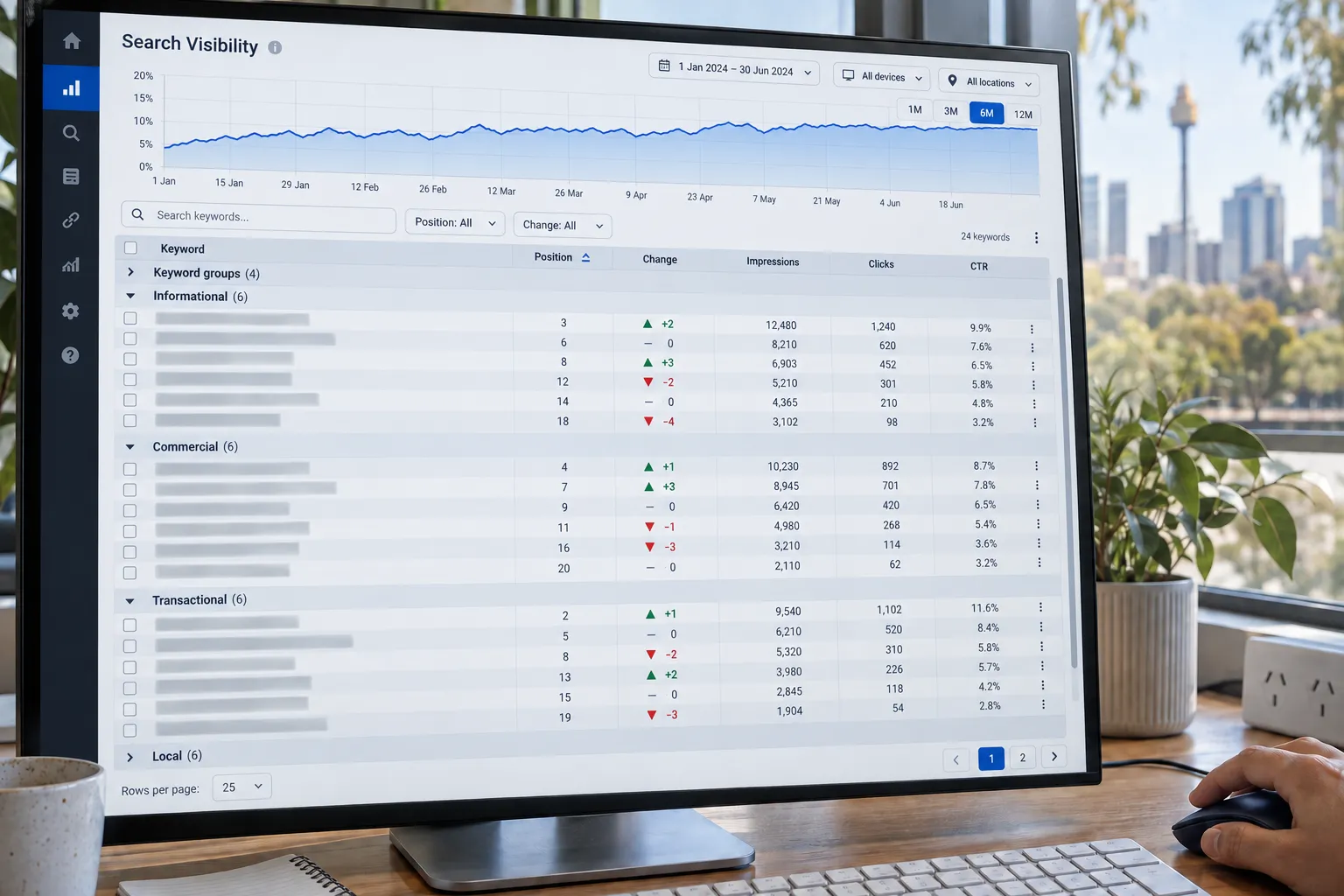
Search visibility and keyword rankings are valuable early indicators of SEO progress. When relevant pages begin appearing for a broader range of suitable searches, the website has more opportunities to attract potential customers.
These figures should not be judged from a single day or week. Search results vary by location, device, language and user context. A consistent trend across priority topics and landing pages is more meaningful than an isolated movement for one keyword.
Google Search Console’s Performance report includes clicks, impressions, click-through rate and average position. Its Performance report includes clicks, impressions, click-through rate and average position. These metrics should be reviewed by query, page, country and device rather than only at the sitewide level.
Important patterns include:
Rising impressions do not automatically mean that more pages have been indexed. They can also result from improved positions, increased search demand, broader query coverage or changes to the search results. Indexing should therefore be checked separately using Search Console's indexing reports and URL inspection tools.
Average position also requires careful interpretation. It is calculated across the searches in which a result appeared, so it can sometimes worsen when a website begins appearing for many new queries in lower positions. Query-level and page-level trends usually provide more useful insight than one sitewide average.
Keyword rankings should be treated as a portfolio rather than a collection of isolated vanity terms. Sustainable progress is reflected in the performance of groups of related keywords connected to important products, services and customer needs.
When assessing rankings, a business should consider:
Location and device also matter. A business serving particular areas should monitor performance in those markets, while mobile and desktop results may need to be compared separately.
Higher rankings only create value when they attract the right audience and support meaningful actions. Target keywords should therefore be mapped to different stages of the customer journey, from initial research to high-intent product or service searches.
If visibility improves for commercially relevant terms and the associated landing pages begin generating more qualified enquiries or sales, SEO is likely contributing to business growth. If rankings rise without any increase in useful traffic or conversions, the keyword targeting, search intent, page content or conversion pathway may need to be reviewed.
If rankings rise without any increase in useful traffic or conversions, the keyword targeting, search intent, page content, conversion pathway or broader SEO strategy may need to be reviewed.
Organic search traffic shows how many people reach a website through unpaid search results. Consistent growth from relevant searches is a positive sign, but total visitor numbers should not be assessed in isolation. The objective is to attract visitors who are likely to engage with the business, not simply to generate more sessions.
Google Analytics 4 and Google Search Console provide complementary information. In GA4, the Traffic acquisition report can be filtered to review Organic Search. Search Console records clicks from Google Search and shows the queries and pages associated with those clicks.
Useful checks include:
The two platforms will not always show identical figures because they use different measurement methods. The focus should be on consistent trends within each platform rather than expecting the totals to match exactly.
An increase in sessions does not prove that SEO is helping the business. Traffic quality can be assessed by examining what visitors do after reaching the website.
When a website receives traffic without enquiries, its keyword targeting, landing-page content and conversion pathways may need further investigation.
Relevant indicators may include:
Engagement metrics must be interpreted in context. A short visit is not necessarily unsuccessful if a person quickly finds a phone number, address or clear answer. Similarly, a long visit does not automatically indicate strong buying intent. Behaviour should be assessed alongside the purpose of the page and its measurable outcomes.
Organic performance rarely moves in a straight line. Demand can change because of weather, holidays, economic conditions, news coverage or industry-specific buying cycles. Search-result features, competitor activity and Google updates can also affect clicks even when a page's content has not changed.
For this reason, year-on-year comparisons are often more reliable than comparing only one month with the month immediately before it. Major changes should also be annotated in reporting, including website migrations, tracking updates, campaigns, service changes and substantial content releases.
Traffic and visibility are leading indicators. The clearest evidence of commercial value is whether organic search contributes to genuine enquiries, customers and revenue.
The actions that matter depend on the business model. A lead-generation website may value contact forms, quote requests, booked consultations and phone calls. An ecommerce website may focus on purchases, revenue, add-to-cart activity and checkout completion.
Important actions should be configured as key events in GA4 or measured through another suitable analytics platform. Typical examples include:
Micro-conversions can help explain the customer journey, but they should not be reported as though they were all qualified leads. A page view or button click has a different commercial value from a completed enquiry or sale.
Organic key events can be reviewed by channel or source and medium. However, attribution is rarely perfect. A customer may first discover a business through organic search, return later through a branded search and finally make contact by phone or direct visit.
Call-tracking software can help connect telephone enquiries with website sessions, while customer relationship management systems can retain the original source and later sales outcomes. Tracking should be implemented with appropriate privacy and consent controls.
Useful figures include:
If visibility and traffic rise but qualified enquiries remain flat, the strategy may be reaching the wrong audience or directing visitors to pages that do not support the next step effectively.
Lead volume alone does not show the full value of SEO. Where possible, organic leads should be followed through the sales process to determine how many become customers and how much revenue they generate.
This is particularly important when comparing channels. Organic search may produce fewer leads than another channel but deliver a higher proportion of qualified opportunities or stronger lifetime value. Reporting revenue and lead quality alongside traffic provides a more accurate view of performance.
Landing-page analysis helps explain why visibility and traffic do or do not translate into results. Instead of relying on a sitewide average, a business should review its most important organic landing pages individually.
Questions to consider include:
Weak engagement should prompt investigation, but it should not automatically be treated as a ranking problem. The page type, visitor intent and completed actions all need to be considered before drawing conclusions.
SEO can underperform even when the content strategy is sound if search engines cannot reliably crawl, index or understand important pages. Technical checks help determine whether the website provides a stable foundation for organic growth.
A technical SEO audit can identify crawlability, indexing, redirect and performance issues that may be limiting organic growth.
Areas to monitor include:
Not every warning has the same business impact. Technical work should prioritise issues that prevent important pages from being discovered, indexed, displayed correctly or used effectively. A sudden loss of indexed pages, organic landing-page traffic or recorded conversions should be investigated promptly.
For businesses serving defined geographic areas, local visibility is an important part of SEO performance. National keyword reports may overlook whether the business is appearing for potential customers in its actual service locations.
Local performance can be evaluated through:
These figures should be interpreted alongside real business outcomes. Direction requests may be valuable for a physical venue, while phone calls and quote forms may matter more to a mobile service provider. Local rank-tracking tools can also provide context, but results vary by the searcher's precise location and should not be treated as exact for every customer.
SEO results generally develop over months rather than days. Some websites may see early movement within three to six months, while meaningful growth in competitive markets can take six to 12 months or longer. These ranges are guides, not guarantees.
The timeframe depends on factors such as:
New websites often take longer to establish visibility because they have limited history and few established signals. Existing websites may improve sooner when clear technical or content problems are corrected, although this depends on how quickly search engines recrawl and reassess the affected pages.
During the first three months, much of the work may involve measurement setup, technical repairs, keyword research, site structure and content planning. Early signs of progress can include resolved indexing problems, increasing relevant impressions and initial movement for lower-competition searches.
From approximately three to six months, some updated or newly published pages may begin earning more impressions, clicks and prominent positions. Results can still be inconsistent, so performance should be evaluated across groups of pages rather than one keyword.
Between six and 12 months, a consistently implemented strategy should provide enough data to identify clearer patterns. The most important question is not whether every ranking has increased, but whether relevant visibility is contributing to better traffic, qualified enquiries and revenue.

Reviewing SEO too frequently can encourage reactions to normal fluctuations, while reviewing it too rarely can allow important problems to continue unnoticed. A layered schedule usually provides a balanced approach.
Weekly monitoring should focus on significant problems rather than minor ranking changes. This may include tracking failures, unusual traffic losses, indexing problems, website outages and sharp declines affecting important pages.
Monthly reviews can assess search visibility, organic traffic, priority landing pages, leads, sales and work completed. Results should be compared with the baseline, the previous period and, where relevant, the same period in the previous year.
Quarterly reviews provide an opportunity to examine broader trends, content gaps, competitors, technical priorities and commercial performance. They can also identify which services, locations or topics deserve further investment and which activities are producing limited value.
SEO does not need to produce uninterrupted growth, but persistent patterns can indicate that the strategy or its implementation needs attention.
Warning signs may include:
The cause should be investigated before making large changes. A decline may relate to technical problems, changing demand, stronger competitors, altered search results, a Google update or content that no longer meets the audience's needs. Reviewing the evidence by query, page, location, device and conversion outcome helps avoid decisions based on assumptions.
Knowing whether SEO is working requires more than checking a handful of rankings. Relevant visibility should lead to qualified traffic, useful engagement and measurable business outcomes, supported by a technically reliable website.
Clear goals, accurate tracking and regular reviews allow a business to distinguish short-term fluctuations from meaningful progress. When search performance is connected with enquiries, sales and revenue, SEO becomes easier to evaluate and improve. The strongest strategy is one that continues investing in activities that deliver demonstrable value while adjusting areas that do not support the organisation's goals.