Request a FREE SEO audit & quote
Unlock the full potential of your online presence with our expert SEO services.

Artificial intelligence is changing how customers search for information, products and services online. Instead of scrolling through pages of links, people are turning to AI search tools that analyse vast amounts of data and deliver a single confident answer or a short list of recommended options. For businesses, this shift has serious implications for visibility, brand perception and revenue. If a company is not included in those AI-generated answers, it effectively disappears from a growing share of digital discovery and decision-making.
At Volcano Marketing, a Sydney-based digital marketing agency, we see firsthand how AI search is reshaping online visibility. Appearing in AI-generated results is becoming just as critical as ranking in traditional search engines, but the rules are different. Businesses need to understand how AI systems source, evaluate and prioritise information, and how factors such as structured data, content quality, brand authority and technical setup influence visibility. Those who adapt early position themselves for a decisive competitive advantage, ensuring that when AI tools answer their customers’ most important questions, their business is part of the conversation rather than left out of sight.
AI search results are reshaping how people discover brands online. Instead of scrolling through pages of blue links, users now receive concise answers, product suggestions and recommendations generated by models like Google’s AI Overviews and ChatGPT. This means a business can gain or lose visibility based on how often and how positively it is referenced inside these AI-generated responses.
For clients, this shift affects everything from website traffic and leads to brand authority. It is no longer enough to rank on traditional search engine results pages. Businesses now need to be recognised and trusted by AI systems that summarise the web and often show only a handful of sources.
Traditional search results present multiple options that users scan and compare. AI search often delivers a single composite answer at the top, which can satisfy the query without any further clicks. If a business is not included or cited in that AI answer, it may be invisible even if it ranks well organically.
AI results also change how users behave. People are asking longer, more conversational questions and expecting immediate direction, such as which service to choose or which supplier is best for a specific need. This creates a winner-takes-most effect where a small group of brands mentioned in the AI response captures the majority of attention.
AI search systems do not just read keywords. They evaluate entities, relationships and trust signals across the web. For a business to appear in AI-generated answers, it needs:
If AI cannot understand or verify a business, it is less likely to surface it in an answer. A digital marketing agency focuses on aligning content and technical SEO with these AI-friendly signals so that businesses are easy for models to interpret and recommend.
In AI, search visibility is less about a single ranking position and more about being cited as a relevant source. AI models pull from multiple pages, reviews, articles and forums to construct answers. A business that is frequently mentioned positively across reputable sites stands a much better chance of being woven into those responses.
This means digital PR reviews and partnerships now have a direct impact on AI visibility. When industry blogs, news sites and customers repeatedly reference a brand, it strengthens the likelihood that AI tools will view that business as authoritative and include it in search answers.
As AI assistants and chat-based search become part of everyday life, customers are increasingly bypassing traditional search results. Instead of clicking through pages of blue links, they get a single trusted answer inside tools like ChatGPT, Gemini or Copilot. If a business is not part of that answer, its brand simply does not appear in the customer’s consideration set.
Experts see this shift as more than a trend. It is a structural change in how people discover products, services and local providers. Failing to show up in AI search responses means handing visibility and market share to competitors who are better represented in the data and sources these systems rely on.
Classic search presents multiple websites on a results page. Even if a brand is not number one, it can still win clicks from positions two to ten. AI search works differently. The assistant usually presents a single summarised response with a few suggested sources. Users often accept that first answer and never scroll further.
If a business is missing from these AI answers:
For example, if an AI is asked to “recommend three local accountants that specialise in small ecommerce brands”, it may surface only firms that have strong, structured information, consistent directory data and content that the model can easily interpret. Everyone else simply disappears from the conversation.
AI systems increasingly blend local data with general knowledge. When a user asks, “Where should I go for lunch near me that has vegan options and outdoor seating?", many assistants now respond with a curated list instead of a map of dozens of pins. Those lists are based on business profiles, reviews, menu data and consistency across platforms.
If a company’s information is incomplete, outdated or not machine-readable, the AI may:
For local and service‑based businesses, this is critical. The shift from “ten blue links” to “three recommended options” concentrates attention on a smaller group. Professionals help clients ensure that their profiles, schema markup and third‑party listings are ready for that kind of AI‑driven filtering.
AI search leans heavily on signals of authority such as clear topical content, consistent branding across the web and mentions in trusted sites. If a business produces little or unfocused content, AI systems have fewer reasons to reference that brand when answering questions.
Eventually, this has a compounding effect. Competitors that are regularly cited by AI:
Meanwhile, a brand that is not surfaced in AI answers appears less relevant and less established, even if it delivers an excellent product or service. For clients, improving AI visibility is not just about traffic. It is about preserving perceived authority as search behaviour evolves.
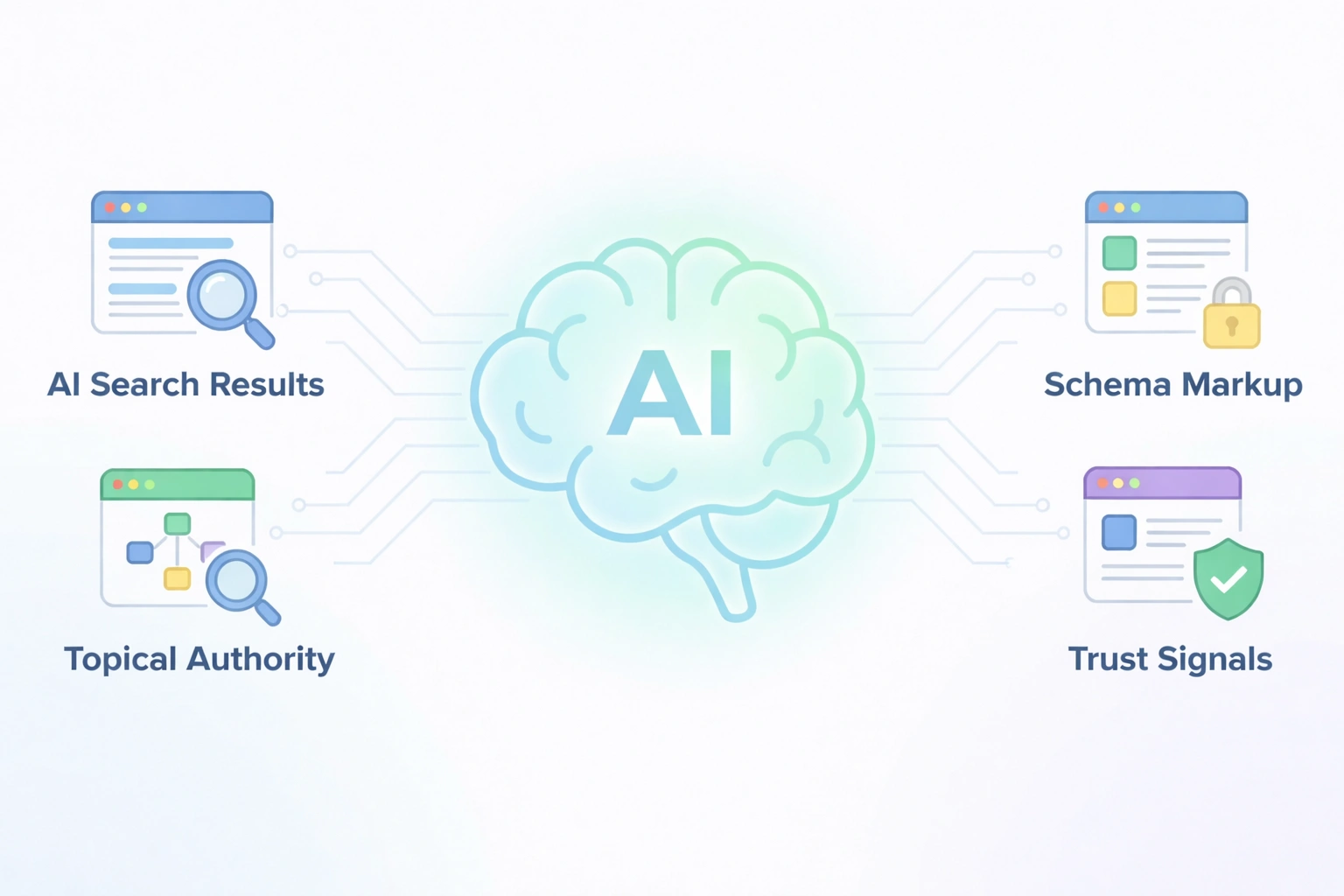
AI search tools rely on understanding, not just keywords. To appear in answers generated by these systems, businesses need content that clearly explains who they are, what they offer and which problems they solve. This requires thinking beyond traditional SEO and optimising for the way AI models interpret, connect and summarise information across the web.
Improving visibility in AI search is about being trusted, structured and easy to interpret. That means publishing content that is accurate, consistent and clearly organised, while ensuring the technical foundation of the website supports machine readability. When information is presented in a way AI systems can confidently verify and understand, the likelihood of being referenced in AI-generated responses increases significantly.
AI models look for sources that appear knowledgeable on a subject. A thin service page is often not enough. Businesses need a cluster of content that signals real expertise.
Instead of a single page called “Accounting Services”, a firm might build out detailed pages on tax planning, payroll, cash flow management and industry-specific advice, then link them together internally. Each page should explain processes, common questions, pricing models and typical outcomes in natural language.
Helpful tactics include:
When AI systems see multiple high-quality pages covering a topic from different angles, they are more likely to treat the site as an authoritative source.
AI search relies heavily on context. Clear structure helps models quickly identify what a business does and where it operates.
Basic on-page actions include using descriptive headings, concise paragraphs and plain language to describe services, locations and audiences. Contact details, opening hours, pricing approaches and service areas should be easy to find and written in consistent formats across the site.
Implementing schema markup is increasingly important. By adding LocalBusiness, Product, Service and FAQ schema, a site gives AI crawlers a labelled data layer that explains key facts in a structured way. This can help AI answers correctly list a company’s services, locations or key features rather than guessing from unstructured text.
AI systems look for signals that a business is credible before citing it in an answer. This extends beyond the website.
Professionals encourage clients to keep their Google Business Profile, major directory listings and social profiles fully updated with consistent names, addresses and phone numbers. Reviews on platforms relevant to the industry help reinforce trust if they are recent and responded to professionally.
Earning mentions and links from reputable industry sites, local media and partners also matters. When AI models see the same business information echoed across multiple trusted sources, it increases confidence that the data is accurate, which improves the chance of being selected in AI-generated search results.
If a business does not deliberately position itself to appear in AI search results, it is effectively surrendering visibility, traffic and potential customers to competitors. AI tools are increasingly becoming another way people search, compare options and make purchasing decisions. They do not simply display a list of links; they select, summarise and recommend answers. This shift demands a different approach to online presence. Website structure, content clarity, reviews, structured data, offers and the way products and services are described must all be consistent, accurate and easy for AI systems to interpret and trust.